Pinball Maze
Problem statement
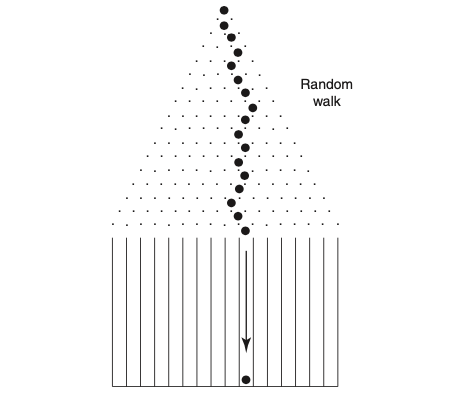
Imagine a pinball maze like the one below. A ball is dropped into the maze N times. A few assumptions: (1) no ball ever leaves the container placed below the maze, and (2) at each pin (each dot in the figure) the ball has only two options — left or right, each equally likely.
The question: as we do this for a large number of throws,
N \rightarrow \infty
what does the distribution of balls across the containers (i.e. the frequency of balls in each slot) converge to?
Simulation
Let’s simulate the situation in Python.
# function for simulating one throw
def oneThrow(numOfLayers):
    # generate left(-1) / right(+1) using a binomial distribution, equal probability
    bernoulliNumbers = np.random.binomial(1, 0.5, numOfLayers)
    decideNumbers = (lambda arr: [-1 if x == 0 else 1 for x in arr])(bernoulliNumbers)
    # final container slot
    finalContainerSlot = 0
    for decide in decideNumbers:
        finalContainerSlot += decide
    return decideNumbers, finalContainerSlot
numberOfLayers = 100
numberOfThrows = 10000
finalContainerSlotArr = [oneThrow(numberOfLayers)[1] for i in range(numberOfThrows)]Each throw is a sum of numberOfLayers independent \pm 1 steps — by the central limit theorem, as numberOfLayers grows, the distribution of finalContainerSlot across many throws converges to a normal distribution. The pinball maze is, in effect, a physical Galton board.